ReadyRESCUE™


Activated charcoal built for the 21st century.
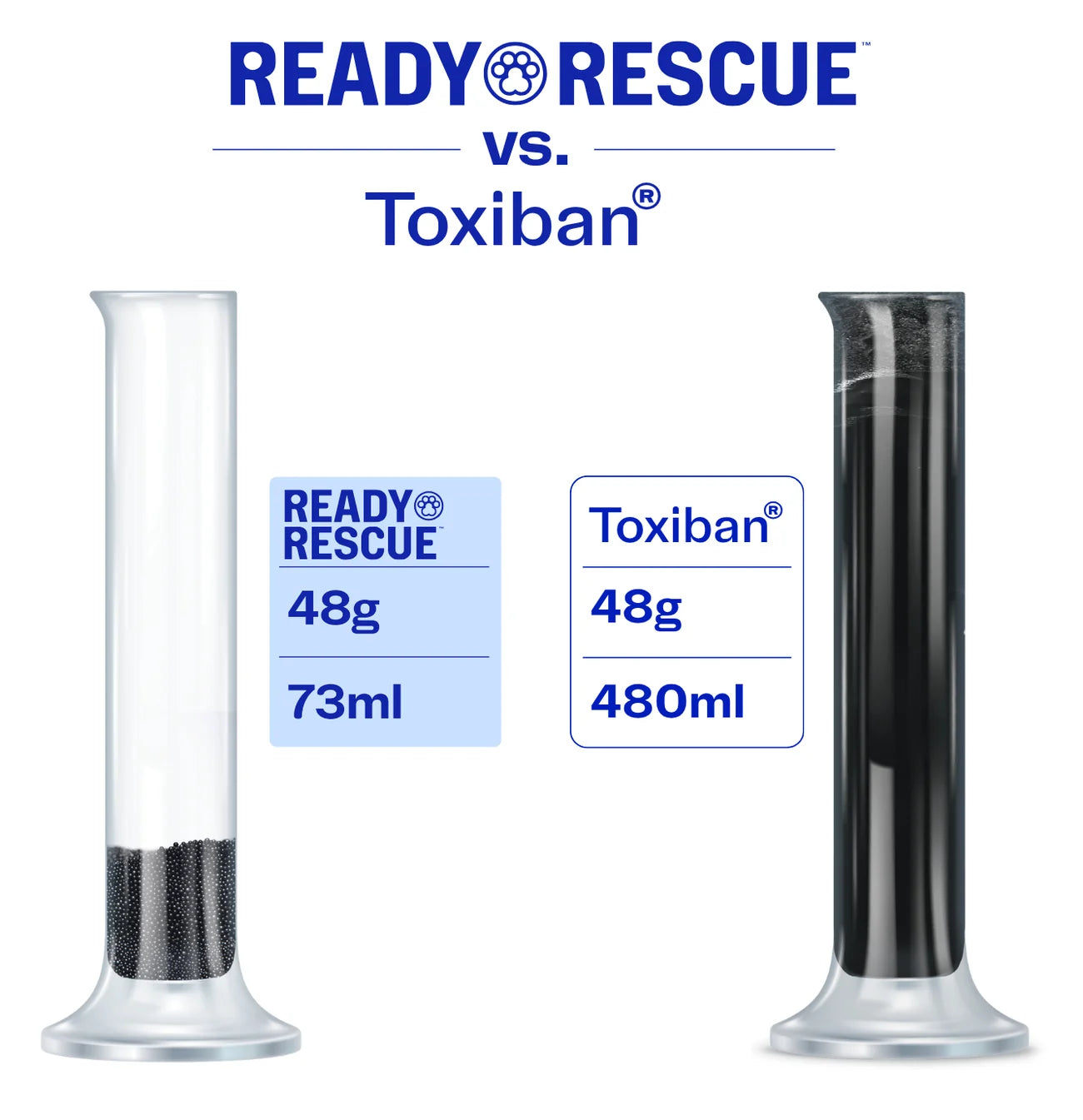
1/7th the volume of Toxiban®. No electrolyte disturbances. No impaction. 5-year shelf life. Clean. Easy to give.
Our patients deserve better. So do the people caring for them.
Activated charcoal is a trusted tool in treating poisoning, but traditional formulations can make an already stressful situation harder. Effective decontamination shouldn't have to come with a battle, a bath, and a change of scrubs.


What veterinary practices are saying about ReadyRESCUE™
Reviews left on Vetcove, the veterinary distributor platform, by practices that ordered ReadyRESCUE™, as written. Most reviewers received a sample.
Built for the veterinary field, by one of its own
Safety & Flexibility
Free of sorbitol and other cathartics, ReadyRESCUE™ avoids cathartic-associated fluid and electrolyte risks while allowing veterinarians to consider higher or repeated charcoal doses for more serious intoxications.
Evidence
Peer-reviewed comparison against Toxiban® and conventional activated charcoal across common veterinary toxicants, published in Frontiers in Veterinary Science.
Practicality
One-seventh the volume of Toxiban® liquid, in clean spheres — the difference between a dose that goes in and a dose that ends up on the wall.
What is ReadyRESCUE™?
ReadyRESCUE™ is a next-generation activated charcoal (activated carbon spheres) — pure activated carbon, with no excipients such as sorbitol, so it does not cause electrolyte disturbances. It does not dissolve in liquid, so intestinal impaction is not a concern with higher or repeated dosages.
Approved for use at UGA, OSU, VEG, BluePearl, VCA, Banfield, Vetco, and more!
Why veterinarians choose ReadyRESCUE™
The questions veterinarians and technicians ask us most, answered from the hospital SOP and the published study.
-
Is ReadyRESCUE™ charcoal?
Yes. It is activated carbon in a dense spherical form: the next generation of activated charcoal. Peer-reviewed University of Georgia testing supports comparable gram-for-gram adsorption to traditional activated charcoal and Toxiban® across most of the toxicants tested, under the study conditions (Chaganti & Brainard 2026, Frontiers in Veterinary Science 13:1741145). See the evidence
-
How do I give it?
If the patient is eating, mix it with a small amount of canned food. If not, add water to make a small slurry, keep the beads suspended by swirling, and give it by mouth or through a tube per your hospital protocol (the SOP calls for an NG tube of 10 Fr or larger). Avoid fatty mixers such as peanut butter. It is one-seventh the volume of Toxiban® liquid, and clean.
-
How do I dose it, and can I give more?
By body weight at 1–4 g/kg, or, when you know how much toxin was eaten, at a 10:1 ratio of ReadyRESCUE™ to toxin. The label dose is about 2.2 g/kg: one 30 g vial treats a 30 lb (13.6 kg) patient. Because the volume is low, a higher gram-per-kilogram dose is practical when it is clinically indicated. Dosing stays your clinical decision, and standard patient-selection and aspiration precautions still apply. Hospital SOP
-
What about cases where Poison Control recommends a cathartic?
Keep the charcoal dose and the cathartic decision separate. ReadyRESCUE™ contains no sorbitol, so increasing or repeating charcoal does not increase cathartic exposure. The evidence for routine cathartic benefit is limited and mixed, and cathartics carry fluid and electrolyte concerns, so whether to add one stays your decision. The hospital SOP does not call for one. Why we left sorbitol out
-
Can I repeat the dose?
Yes, where repeated dosing is clinically indicated, and a repeat dose does not repeat a cathartic. The spheres do not dissolve, so intestinal impaction is not a concern with higher or repeated doses. For toxins with enterohepatic recirculation, such as NSAIDs, bromethalin, THC and barbiturates, the SOP recommends 0.5–1 g/kg every 6–8 hours for 2–3 doses. Expect beaded stool for 24 hours.
-
Can owners give it at home?
In appropriately selected cases, a veterinarian may direct owners to give repeated doses at home, with clear instructions. That is veterinarian-directed use, not a replacement for veterinary evaluation or Poison Control guidance. A general practice can also start charcoal in an appropriate patient before transferring it to an emergency or referral hospital.
-
What about cats?
The low volume is particularly practical for cats and small dogs. Dose them by body weight, as you would any patient.
-
How long does it last, and where do I buy it?
It has a five-year labeled shelf life at room temperature, so a practice that rarely needs charcoal can keep it on the shelf without it expiring first. Order it through your veterinary distributor or directly from us. How to order
No sorbitol, on purpose
Sorbitol has traditionally been added to activated charcoal to accelerate gastrointestinal transit and potentially reduce toxin absorption. ReadyRESCUE™ takes a different approach—one grounded in the evidence and designed to give veterinarians greater control over decontamination.
-
The theory behind sorbitol
Sorbitol is an osmotic cathartic added to activated charcoal to accelerate gastrointestinal transit. The rationale is simple: move the toxin through the GI tract faster, reducing the time available for absorption. But faster transit does not necessarily translate into better decontamination.
-
The evidence is far from convincing
In dogs, adding sorbitol to activated charcoal has not improved decontamination: after a carprofen overdose, charcoal with sorbitol did no better than charcoal alone, and with acetaminophen a cathartic diminished the charcoal’s effect. In people the experimental data are conflicting, and the joint position paper of the American and European clinical toxicology associations does not endorse the routine use of a cathartic with activated charcoal. Consequently, sorbitol is not recommended for routine use in poisoning management.
Koenigshof et al., J Vet Emerg Crit Care 2015 (carprofen overdose in dogs); Van de Graaff et al., J Pharmacol Exp Ther 1982 (acetaminophen in dogs); Position paper: cathartics, J Toxicol Clin Toxicol 2004 (AACT and EAPCCT).
-
More charcoal. More flexibility. No cathartic.
Even studies reporting a benefit from sorbitol suggest improvements of approximately 30%. ReadyRESCUE™ delivers equivalent grams of activated carbon in roughly one-seventh the volume of Toxiban® liquid, making higher doses far more practical. Rather than relying on a cathartic, veterinarians can increase the charcoal dose when clinically appropriate, potentially increasing toxin adsorption without adding sorbitol-associated fluid and electrolyte risks.
The Veterinary Toxin Assistant Free resources built by the ReadyRESCUE™ team
The toxin call, worked up in twenty seconds.
Signalment, agent, amount, time, signs. The Toxin Assistant returns the exposure dose with the arithmetic shown, the risk band against published thresholds, the decontamination decision, treatment and monitoring, each line tagged to its source. Free for veterinary teams, built by the ReadyRESCUE™ team.
- Every number has a source Thresholds and doses come from published literature: the Merck Veterinary Manual pages named on each card, the ReadyRESCUE™ hospital SOP and the ReadyRESCUE™ Pet Owners' Guide to Pet Poisoning. Anything from a standard reference says verify.
- Exposure is calculated for each specific case entered Dose, risk band and charcoal dose are worked out from the weight and the amount you enter. The band comes from published thresholds, never from the model.
- Free emergency information, the way it should be A free resource for veterinary hospitals, so veterinarians have the information they need at their fingertips without paying a business a fee. Flag anything wrong from inside the note; it goes to the ReadyRESCUE™ team.
ReadyRESCUE™ product overview
Using ReadyRESCUE™ in your practice
Three ways veterinary teams put it to work, in the order a case unfolds: in the hospital, sent home after a toxicity, and sent home for an emergency.
Decontamination in the treatment room
ReadyRESCUE™ is applied in the management of oral toxin ingestion, at the direction of the attending veterinarian. The patient eats it mixed into canned food or another treat, or it goes in with water through an NG tube. There is no sorbitol, which avoids sorbitol-associated fluid and electrolyte concerns, and the spheres do not dissolve, so impaction is not a concern with higher or repeated doses. Like all activated charcoals, it will adsorb any orally administered medication.
Dosing at a glance
| Label dose | 2.2 g/kg. Each 30 g vial treats 30 lb (13.6 kg); animals of 15 lb and under take ½ vial |
|---|---|
| Massive intoxication | Double dose, 4.4 g/kg |
| By patient weight | 1–4 g/kg |
| Known weight of toxin | 10:1, ReadyRESCUE™ to toxin (10 g to 1 g) |
| How it is given | In canned dog food or another treat (not peanut butter), or in water through an NG tube of 10 Fr or larger |
| Storage | Room temperature |
From the ReadyRESCUE™ Hospital SOP.
Open the Hospital SOPRepeat doses at home, at your direction
Toxins with enterohepatic recirculation, notably NSAIDs, bromethalin, THC, barbiturates and certain chemotherapeutics, can persist for many hours after ingestion. For these the SOP recommends repeated charcoal to disrupt reabsorption and shorten the toxin's half-life, with close monitoring for dehydration and GI motility. ReadyRESCUE™ can be sent home with the owner for the remaining doses. Because it is sorbitol-free, a repeat dose does not repeat a cathartic, and because the spheres do not dissolve, impaction is not a concern. Owners should expect beaded stool for 24 hours.
Repeat charcoal, by toxin
| Toxin | Repeat? | Frequency and duration |
|---|---|---|
| NSAIDs (carprofen, naproxen, ibuprofen) | Yes | q6–8h for 2–3 doses |
| Bromethalin rodenticide | Yes | q8h for 2–3 doses |
| Marijuana / THC | Yes | q6–8h for 24h |
| Barbiturates (phenobarbital) | Yes | q6–8h for 24–36h |
| Theophylline, caffeine | Yes | q6–8h for 24h |
| Cholecalciferol (vitamin D rodenticide) | Yes | q8h for 2–3 doses |
| Ivermectin | Yes | q8–12h for 24–48h |
| SSRIs / TCAs | Case-by-case | If clinical signs prolonged |
| Xylitol, ethylene glycol, heavy metals | No | Not effective |
From the ReadyRESCUE™ Hospital SOP.
Open the Hospital SOPFor the client who lives far from care
For at-risk animals, and for animals that live a long way from emergency veterinary care, ReadyRESCUE™ can be sent home for emergency use. The owner starts decontamination at your direction while they call you and travel, rather than after the drive. The label dose is 2.2 g/kg: each 30 g vial treats a 30 lb (13.6 kg) patient, and animals of 15 lb or less take half a vial. It is one-seventh the volume of Toxiban® liquid and clean, so an owner can give it themselves.
Label dose chart
| Weight | Vials | Grams |
|---|---|---|
| Dogs/Cats ≤ 15 lbs. | ½ vial | 15 |
| Dogs 16–30 lbs. | 1 vial | 30 |
| Dogs 31–60 lbs. | 2 vials | 60 |
| Dogs 61–90 lbs. | 3 vials | 90 |
| Dogs 91–150 lbs. | 5 vials | 150 |
From the product label: 1 g per lb of body weight (2.2 g/kg).
Open the Hospital SOPThe evidence
peer-reviewed comparison, published in Frontiers in Veterinary Science: comparable gram-for-gram adsorption to Toxiban® and conventional activated charcoal across most of the toxicants evaluated, under the study’s conditions. Preliminary ReadyRESCUE™ data support its adsorption of acetaminophen.1
the volume of Toxiban® liquid for an equivalent dose, which is what makes an at-home administration realistic for an owner.1
grams per kilogram, the dosing range in the ReadyRESCUE™ hospital standard operating procedure; or a 10:1 ratio to a known weight of ingested toxin.2
References
-
Chaganti, A., & Brainard, B. M. (2026). Comparison of adsorptive capacity for different types of activated charcoal for common veterinary toxicants. Frontiers in Veterinary Science, 13, 1741145.
Read the study -
ReadyRESCUE™ Hospital Standard Operating Procedure.
Open the SOP
Clinical resources
The documents behind the product, with the free Toxin Assistant, in one place.
Hospital SOP
Standard operating procedure for administration in practice: authorised staff, indications, dosing by weight or by toxin ratio, and the comparative adsorption data.
Open the SOPUniversity of Georgia adsorption study
Peer-reviewed comparison of adsorptive capacity for different types of activated charcoal across common veterinary toxicants. Chaganti, A., & Brainard, B. M. (2026). Frontiers in Veterinary Science, 13, 1741145.
Read the studyReadyRESCUE™ versus Toxiban®: crossover study
A prospective randomized crossover study of administration efficiency, clean-up burden and delivered dose of activated charcoal in dogs. Glassman, M. AllPet Inc.
Read the studyProduct overview video
Administration, workflow and real-world use, presented by the founder, a veterinary surgeon.
Watch the videoThe Veterinary Toxin Assistant
Free toxicology consults for veterinary teams: the exposure dose with the arithmetic shown, the risk band, the decontamination decision, doses and monitoring, every line sourced.
Open the Toxin AssistantHow to order
ReadyRESCUE™ was crafted by veterinarians for easy use in any context: whether it's providing a first-of-its-kind at-home option for pet parents, or updating an outdated detoxification method at the veterinary hospital, ReadyRESCUE™ helps keep pets safe from everyday toxins.
Interested in stocking ReadyRESCUE™? For clinics, shelters, and retailers — contact hello@readyrescue.com and we'll get you set up.
Order through your distributor